Showing posts with label Neighbours. Show all posts

Wednesday, December 12, 2007

MissionGTA

I did my city wide activities today. I participated in a MissionGTA meeting and in our local ministerial in Thornhill. MissionGTA is a region wide (GTA is the Greater Toronto Area) organization that attempts to gather Christian leaders for united prayer geared toward seeing positive transformation of all the spheres of life in our city. I pulled the following off the newly revamped (not fully complete) website to give you a bit more info.

This is our strategy ...

* Connecting various groups who are already causing a transformational impact in the different spheres of society as identified by the key indicators, and where such groups do not exist encourage their formation.
* Providing representative leaders of the different geographical communities of the GTA with opportunities for interaction, prayer and strategy formation.
* Providing representative leaders of the different ethnic communities of the GTA with opportunities for interaction, prayer and strategy formation.
* Mobilizing unified intercession through the efforts of PrayGTA.
* Providing the Body of Christ with opportunities for regional prayer gatherings (including City Hall Prayer, Prayer Summits and Global Day Of Prayer).
* Encouraging the creation of a communication hub for all Christian activity in the GTA.

The Thornhill Ministerial on the other hand is our local gathering. It involves seven churches in my immediate area where the pastoral staff of these congregations meet once a month. It involves Lutheran, Anglican, Baptist, Presbyterian, United, Roman Catholic and Pentecostal churches. It really is quite collegial and quite enjoyable but not particularly spiritual or prayerful. Our major event is an annual Lenten series of meetings where we swap pulpits for the six Sunday evenings of Lent. It is nice to be able to participate in the various traditions but the concern continues to be that younger families and youth don't attend. (After hearing the particularly somber music at one of these Lenten services my son (12 years old at the time) quipped: "Don't they want people to attend these meetings?" I force my family to come at least once during Lent - the Sunday I'm speaking.

My other "ministerial" involvement is with my area denominational meetings. They happen infrequently - only three or four times a year.

However, if I went to every event, meeting, conference, prayer breakfast, or seminar designed to assist, inform, unify or equip the local clergy, I could be busy 532 days per year. The power to choose must be exercised to be healthy!

Thursday, September 06, 2007

High Holy Days

L'Shanah Tovah (Happy New Year) & Chag Sameach (Literally, joyous festival.)
Well technically the first phrase is L'shanah tovah tikatev v'taihatem (May you be inscribed and sealed for a good year). If you want to impress your Jewish neighbour say the whole phrase - and know what it means (some less observant Jews may not know).

As the Jewish High Holy Days approach (Rosh Hashanah begins on the evening of September 12th and Yom Kippur is sunset September 21, 2007 - nightfall September 22, 2007) my neighbourhood is abuzz with preparations. There is significance for us who profess that Moshiach has come in Jeshua as well because the Jewish feasts reflect Biblical events and concepts and point toward the coming of the Messiah.

Each one of God’s Feasts contains basic elementary truths, which are foundational in revealing His Holy character, man’s nature and our faith in Him. As we become aware of the fundamental essentials of each Feast, we gain a deeper understanding of God’s Person and His personal love for humanity. Each one of God’s Appointed Times (feasts) contain the following basic elements (there are more):

The Commemoration of a monumental event. Each Feast Day recounts something fantastic God has accomplished mainly for, but at times in conjunction with, His covenant people.

The Unveiling of Components of His redemptive plan for humanity. God discloses His plan to bring about redemption through the subject matter of the individual Feasts and as God’s Feasts are celebrated, an amazing redemptive portrait reveals itself through the unique practices of the Feast and through the types of sacrifices and the ceremonial protocol outlined for the Tribe of Levi.

The Revelation of His Character through types and shadows. The Person of Messiah is made known through a variety of spiritual and physical appearances, and through miraculous components imbedded within the original historic event.

The High Holy Days are no exception, as a matter of fact, it is in these last three Feasts on the Jewish calendar where the Personhood of Yeshua’s Messiahship and His Crowning as King over all becomes clearly evident. Through these monumental Festival events God’s redemptive plan for Israel is revealed through types and shadows. So, for believers the Feasts of Rosh Hashanah (Trumpets), Yom Kippur (Day of Atonement) and Sukkot (2nd Harvest & God Among us) reveal Messiah as Redeemer, Conqueror and King.

Rosh Hashanah in the Bible
“Again the LORD spoke to Moses, saying, ‘Speak to the sons of Israel, saying, “In the seventh month on the first of the month, you shall have a rest, a reminder by blowing of trumpets, a holy convocation. You shall not do any laborious work, but you shall present an offering by fire to the LORD.’” Leviticus 23:23-25 NASB

Rosh Hashanah Facts
• Rosh Hashanah literally means “Head of theYear” and this is why it is commonly referred to as the Jewish New Year.
• In the Bible, Rosh Hashanah is calledYom HaTeruah or “Day of the Shofar”.
• The command from God concerning the shofar blasts, or the “blast of horns” can be found in Leviticus 23:24 and Numbers 29:1.
• The Bible also calls this dayYom Ha-Zikkaron or “The Day of Remembrance”. Rabbinic Judaism interprets this to mean that the creation of the world by God’sWord was actually on the day of Rosh Hashanah. Therefore, it is “the commemoration of the creation of the world” and Jews are reminded of their responsibilities as God’s chosen people.
• Rosh Hashanah is the beginning of the “Days of Awe” or the 10 days between Rosh Hashanah and Yom Kippur.
• Rosh Hashanah is known by the rabbis as the “Day of Judgment” and it is believed that God judges all of His people on this day and decides on their fate for the next year.
• Maimonides regarded the shofar blasts on Rosh Hashanah as an allusion to Isaiah’s proclamation, “Awake, O you sleepers, awake from your sleep! O you slumberous, awake from your slumber! Search your deeds and turn in repentance!”
• Another long-standing rabbinic tradition is called Tashlikh, or the “Casting off of Sin”. On Rosh Hashanah, many Jews walk to a creek or a river and cast bread crumbs into it, symbolizing the casting off of their sins of the previous year. This is done on the afternoon of the first day of Rosh Hashanah.

Yom Kippur in the Bible
“And He,YHVH spoke to Moses, saying: ‘On the tenth day of this seventh month is the Day of Atonement; there shall be a holy convocation unto you, and ye shall afflict your souls; and ye shall bring an offering made by fire unto YHVH. And ye shall do no manner of work in that same day; for it is a day of atonement, to make atonement for you before YHVH your God.’” Leviticus 23:26-32

Yom Kippur In The Synagogue
• The 10 days between Rosh Hashanah and Yom Kippur are known as the “Days of Awe.” During this period,
“mitzvotim”, or good deeds, are done to make up for bad behaviour during the past year.
• Yom Kippur, celebrated on the 10th day of Tishri, is the most important and solemn of Jewish holidays, next to
the Shabbat due to its frequency.
• Yom Kippur is the occasion on which otherwise non-observant Jews are most likely to attend synagogue, refrain
from work, or fast.
• Throughout the Day of Atonement, Jewish people seek God’s forgiveness through fasting and prayer.
• No leather is worn on this day in remembrance of the sacrifices once offered by the priests in the temple.
• The Day of Atonement is believed by the rabbis to be the people’s last chance to change God’s mind concerning
the judgment of one’s deeds in the previous year, and their humility will effect His decision over one’s fate in
the coming year.
• It is traditional to break the fast of the day with an evening congregational meal.
• In the Bible,Yom Kippur is called, “Shabbat Shabbaton” (Sabbath of Sabbaths); because it is on Yom Kippur that all the people of Israel are to abstain from work and focus inwardly and solemnly, therefore, characterizing a Shabbat of the most complete rest.

Thanks to Light of Messiah Ministries newsletter for much of this information. For a website from a Jewish perspective with lots of helpful information about Jewish culture and holy days check out Judaism 101.

Wednesday, August 29, 2007

Michael Vick Finds Jesus

My second item. There has been a great deal of publicity directed towards the case of Michael Vick, the Atlanta Falcons quarterback who confessed to being involved in dog fighting. In his televised apology he said that he had found Jesus. A number of other public figures have spoken of finding Jesus (Anna Nicole Smith and Paris Hilton to name two more recent ones). Scot McKnight at Jesus Creed asks: “How do we (as Christians) respond to these type of statements?” My prayer is that Jesus has met him and encountered him at the deepest level - so that he could never go back to anything less satisfying. However, a flurry of comments suggested how some might respond to this statement – including mine - which I included below.

One person said we … “would forgive his debts,” to which I responded:

What debts? All his debts? To whom does he owe those debts? Not to me unless I consciously “took” offense.
I really am wondering about this issue. Maybe it is a result of the media’s hanging out everyone’s dirty laundry and once we see it we feel we have an obligation to respond or judge. I’m wondering what my (or any sincere Christian’s) responsibility is in extending forgiveness to what is really a private (or at least personal) wrong.
The same question stands before us in evaluating his faith commitment. How can I possibly evaluate it? How can I make any judgement on it at all? Do I know him? Does he know me? Can I see his daily life? Is he accountable to me?

On a slightly different tack, the concept of forgiveness has come up a number of times. Yesterday, a neighbour (with whom I have been discussing some issues of forgiveness) asked me if I forgave Michael Vick. My response was “What is there for me to forgive?” I don’t know him. He has never hurt me. He hasn’t harmed my world (any more than a thousand others who have committed crimes). He may have harmed some dogs (or allowed them to harm each other). He may have done something that I find morally wrong. He has confessed to doing something illegal.

But I don’t understand how I could forgive him, or refuse to forgive or have any need to forgive him. Doesn’t a long distance (ie not personal or relational) forgiveness or unforgiveness put me in the position of God and Judge - just as the Pharisees accused Jesus of doing?
Now some teachers of the law were sitting there, thinking to themselves, “Why does this fellow talk like that? He’s blaspheming! Who can forgive sins but God alone?” Mark 2:6-7
Do we have any responsibility or right to forgive the sins of someone we have never met or who has never wronged us?

I think it’s difficult enough to forgive my spouse and my neighbour – the people we do know and whom we must forgive.

Thursday, August 23, 2007

Neighbouring

As I was in my DMin class discussing the changing culture and even geographical landscape we began to talk about the significant population concentrations happening in downtown Boston because of the many condos going up. These are high end condos with gates and security guards and video cameras. Our prof was talking about putting together a flyer to invite these folks to their church (only a few blocks away). My suggestion was, why not help someone buy a condo in this building so that they could move in and have a neighbourhood style impact? It would allow them to have a small group meet in the building, access to the "party room" for meetings and daily contact with many residents. The prof had never considered that type of community outreach before.

I am also convinced that in our diversified but ever more segregated world it will be more and more difficult to use mailings as an effective way of communicating your message. Internet advertising may help but it is difficult to target small groups of people located in a specific neighbourhood. Personal contact is always the best way to go. So to have an impact in a "closed" community you need to become a part of that community. You need to move into the neighbourhood.

I'm not alone in my thoughts. Alan Roxburgh is now echoing the same sentiments in his blog and I've quoted a few of the more relevant paragraphs.

I have this sense that God is calling us to move into neighborhoods in cities, towns and villages to quietly form Christian life around a Rule of Life and a set of practices. The formation of a missional order, a band of people moving back into the neighborhood for the sake of the people, place and future of where they live. So I imagine that perhaps, in this simple and unpretentious way God might be wanting to give life and meaning back to the suburbs, inner cities, condo towers and gated housing projects where people are warehoused, commodified and so deeply, crushingly abandoned and alone in a culture shaped by spending and buying. I’m convinced that the only way we can discover and sustain this kind of mission-shaped life is through the formation of some kind of order.

One of the themes you will pick up from Allelon as we seek to understand the ways of forming a multi-generational network of missional leaders is the call to re-enter neighborhoods and go local. We are compelled by the imagination of the Gospels were we are told that God came and pitched its tent beside ours in Jesus. We believe there is a deep call to re-enter neighborhoods. In the manner of Luke 10: 1-12, we are sensing that in the suburbs, cities and towns we are being asked to participate in a movement that vulnerably lives in, among, beside, for and with the other in our neighborhoods. We believe that answers to the questions of what God is up to in our time and what churches need to look like can only be answered from those willing to risk leaving behind their baggage (no bag, no cloak, no extra sandals) and entering the hospitality of the other. We are also convinced that this shift in imagination and practice calls for a missional order that seeks to intentionally live out of a rule of life.

Saturday, June 30, 2007

Back Home Again


I arrived safely home last night at around ten. Even before I drove into my driveway I was reminded of why God called me here. My neighbour flagged me down and asked "How was Boston?" And then talked to me about his ailing mother and his prayers for her. Brigitte and I went for a walk later and talked to another of our neighbours about a significant spiritual experience he had. Then today we spent the afternoon with another of our neighbours. Neighbourhood life is rich and full and filled with God encounters as we see Jesus in the face of those around us.

My trip home was mostly uneventful but I found out later that the Mohawk Indian nation had roadblocked the bridge to Canada (at Cornwall/Hogansburg) and part of the 401 highway between Cornwall and Toronto earlier in the day and had planned on blocking it for the duration of the weekend. Fortunately some kind of settlement had been reached earlier in the day and I made it home in a timely fashion.

I drove through New Hampshire and Vermont and it is pretty there. The day was sunny and not too hot. I took some pictures as I drove along - and I am amazed at how nice they turn out going 100+ km/hr. The daytime picture is in Vermont and the sunset is just west of Trenton on the 401.

Although I enjoyed my time in Boston, it's nice to be home. However I won't see my daughter Kirstyn for another four weeks because she left for Germany last week before I got home from Boston. She's been blogging some of her thoughts and experiences at her blog. Check it out and leave a comment to let her know people are thinking of her.

Friday, June 22, 2007

First Week

We just finished our first week. It has been a very good week with lots of interaction and exchange of ideas. The main focus of this week of class has been the history of Christianity since the Reformation. We have looked at Martin Luther, Huldrych Zwingli, Zinzendorf, Jonathan Edwards, George Whitefield and the revivals and awakenings that happened as a result of their ministry. Fascinating stuff.

A number of things really jump out at me. The first thing was how closely connected the church was to the state and how difficult it was to actually express new ideas without getting censured, exiled or killed. These were brave men to express and stand on their convictions.

The second insight is the amazing similarity of some of the moves of God in the 1700's. During Zinzendorf's time they experienced a pentecost at Herrnhut (the Moravian community he established) complete with shakings, a tangible presence of the Spirit, healings and a deep experience of the love of God. During the Wesleyan revivals and during the Great Awakening there were swoonings, tears and loud screeching during the services as people were brought under the conviction of the Holy Spirit. There were many more supernatural manifestations than we are normally led to believe.

The third thing is what impact the revivals had on our history as the Western Civilization. These awakenings and revival have really shaped who and what we are as a country and as a people. It established morals and ethics and governmental systems that have strong biblical foundations.

Finally, I was impressed at how they expressed their Christianity in the social realm. The result of these revivals was orphanages, hospitals, schools, universities and the relief of poverty. The changes were not only political but deeply social and made a difference in the day to day life of one's neighbour. It has inspired me to see that the significance of the move of the Spirit is always felt in loving your neighbour.

Thursday, June 07, 2007

Longing for A Front Porch

A little while ago I blogged about "third places" - a place that's not home and not work, but where we can hang out and connect with people. Why do we need such places? - mostly because home is too personal and intimate and work relationships need to be kept more distant and professional. Why are we now hearing about third places and finding a place where everyone knows your name? Is this such a new concept? Maybe not. Before our world got so crazy, people did hang out in their neighbourhoods - that is before we had supercentres instead of main streets and before we drove everywhere (because there are no general stores/corner stores anymore), before we had automatic garage door openers, and before we had 492 channels 24-hours a day ... before those things, the front porch used to be one of the major places to connect with people.

The following quote is from a website that is called The Evolution of the American Front Porch that I saw in one of my books (The Search to Belong - look at the list of books at the left).

For the front porch existed as a zone between the public and private, an area that could be shared between the sanctity of the home and the community outside. It was an area where interaction with the community could take place. For "the master's farm business, the mistress's selections of goods and produce, the home craftsmen's sales, and sundry negotiations of the cooler sort (with the hired man, the foreman, the slave or house servant, the distressed or disgruntled neighbor, even with the unpredictable stranger from the muddy road) could all be conducted in the civil atmosphere offered by the shade of a prominent porch, apart from the sleeping and feeding quarters and without serious risk to the family's physical and psychic core"

The porch further fostered a sense of community and neighbourliness. In the evenings, as people moved outdoors, the porch served to connect individuals. The neighbours from next door might stop by one's house, to sit on the porch and discuss both personal and community issues. The couple walking down the street might offer a passing "hello," as they passed house after house whose inhabitants rested outdoors. The porch brought the neighbourhood and community together, by forcing interaction and an acute awareness of others. Indeed, the front porch and the ideal of community in America had developed into a congruous union.

Between the rise of the front porch in the middle nineteenth century and its decline in the post World War II era, the front porch developed a cultural significance. It represented the cultural ideals of family, community, and nature. As these ideals would decline in importance in American culture, so would the porch."


I still think people hunger for these "median spaces." For a while it was replaced by the mall. But I think the current expression of median places is Starbucks (or something like it).

Monday, April 23, 2007

Wild Storm

Around four this afternoon we had one very scary storm. Some of our neighbours had seen a funnel cloud and there was a great deal of damage to property around my neighbourhood. On my street we had many shinglesblown off roofs, chairs and tables tossed around like toys, fences toppled and on my house I lost some fascia.

More significantly hydro poles and light standards toppled over cutting power to our house and much of Thornhill. Bathurst Street is still closed five hours later as is Bayview Avenue and Yonge and Keele Streets.

Traffic was horrendous. You can see a pole that had fallen on top of a car in the picture to the right (I had to use my cell phone camera - sorry about the poor quality).


The police had completely blocked off access from our street to Bathurst because of the hydro lines that were lying on the road. We could not even cross Bathurst Street on foot because of the danger posed by the wires. One of my neighbours had made it home from work as far as the other side of the street and couldn't drive or even walk the last few hundred metres because of the wires. I of course was out there directing traffic trying to help people who had been forced off Bathurst into my neighbourhood - trying to find some way to get past all the closures.

The loose facsia means a bit more work for me. I wanted to go out right away to get some replacement fascia but of course the roads were all blocked and I couldn't get through. Let's hope I can do it tomorrow. The other thing that happened was that I was preparing my taxes this afternoon - on the computer just as the power went off. Fortunately I had been saving frequently and didn't lose any work of significance. The power came back on in time for me to finish them off tonight. I will "Netfile" tomorrow.

The one really good thing about the storm is that it brought all the neibhbours out. We were all standing outside talking and complaining for hours. It was so nice to see many of them again after a long cold winter. It's amazing what a little storm can do!

Saturday, April 14, 2007

Zvi's Bike

I went with Zvi (my friend and neighbour) to Bike Depot today and he got himself a new bike! A very nice Specialized Rockhopper.

Looking at some of the bikes they have there (I saw one for $5500) made me realize that I have a nice bike that I really haven't ridden much over the past couple of years. It is an older bike (I put it together with my bike courier buddy while I was still working at Evergreen) but very nice and very light. It has a Rocky Mountain frame and a lot of LX and XT parts on it.

I used to ride it back and forth to work (45 minutes each way) when we lived in Don Mills and it certainly gave me a great workout. As Spring rolls around I think I need to slip on the helmet and the sweats (you don't want to see me in bicycle shorts) and get a good sweat going as I enjoy the great outdoors.

Wednesday, April 04, 2007

Palm Sunday and Passover

These two holidays do not always coincide but this year they do. It was quiet in my neighbourhood today. Most of my neighbours are Jewish and Passover is one holiday that almost everyone observes with a seder or at least a family meal with some of the traditional elements included.
As for Palm Sunday, we didn't have palm branches but we did talk about the gates ( 7 Lift up your heads, O you gates; be lifted up, you ancient doors, that the King of glory may come in. 8 Who is this King of glory? The LORD strong and mighty, the LORD mighty in battle. Psalm 24).

Sunday evening I participated in a Palm Sunday Prayer Assembly at the Toronto Chinese Pentecostal Church down on Duncan Mills Road. It meets in a ten story office building and occupies most of the the first floor and the basement. Kind of an interesting concept. I took a couple of pictures of the space inside showing the pastor (Josephine Kok) leading our prayer time.

Dexter Quinlan ... also shared about the Global Day of Prayer coming up on the next major Jewish festival - Pentecost Sunday, May 27th, 2007 at the Ricoh Coliseum.

I had a chance to speak and spoke on the significance of Nehemiah to city wide prayer. I've included my main points below.

Who are the gatekeepers? - the people who live in the neighbourhood – the hands and feet of Jesus
a. Nehemiah – was concerned that the city walls and gates were broken down
Nehemiah 1
1 The words of Nehemiah son of Hacaliah: In the month of Kislev in the twentieth year, while I was in the citadel of Susa, 2 Hanani, one of my brothers, came from Judah with some other men, and I questioned them about the Jewish remnant that survived the exile, and also about Jerusalem. 3 They said to me, "Those who survived the exile and are back in the province are in great trouble and disgrace. The wall of Jerusalem is broken down, and its gates have been burned with fire."
4 When I heard these things, I sat down and wept. For some days I mourned and fasted and prayed before the God of heaven. 5 Then I said: 7 We have acted very wickedly toward youI was cupbearer to the king.
-
b. Went to Jerusalem and challenged and organized the people and everyone worked one beside the other
Chapter 2:17 Then I said to them, "You see the trouble we are in: Jerusalem lies in ruins, and its gates have been burned with fire. Come, let us rebuild the wall of Jerusalem, and we will no longer be in disgrace." 18 I also told them about the gracious hand of my God upon me and what the king had said to me. They replied, "Let us start rebuilding." So they began this good work.

c. Each one did his part
Chapter 3: 17 Next to him, the repairs were made by the Levites under Rehum son of Bani. Beside him, Hashabiah, ruler of half the district of Keilah, carried out repairs for his district. 18 Next to him, the repairs were made by their countrymen under Binnui [g] son of Henadad, ruler of the other half-district of Keilah. 19 Next to him, Ezer son of Jeshua, ruler of Mizpah, repaired another section, from a point facing the ascent to the armory as far as the angle. 20 Next to him, Baruch son of Zabbai zealously repaired another section, from the angle to the entrance of the house of Eliashib the high priest. 21 Next to him, Meremoth son of Uriah, the son of Hakkoz, repaired another section, from the entrance of Eliashib's house to the end of it.

d. Satan is disturbed when we take our position and exercise our authority
Chapter 2: 10 When Sanballat the Horonite and Tobiah the Ammonite official heard about this, they were very much disturbed that someone had come to promote the welfare of the Israelites.

e. Expect opposition and ridicule
Chapter 2:19 But when Sanballat the Horonite, Tobiah the Ammonite official and Geshem the Arab heard about it, they mocked and ridiculed us. "What is this you are doing?" they asked. "Are you rebelling against the king?"

f. Satan has no part of the city
Chapter 2:20 I answered them by saying, "The God of heaven will give us success. We his servants will start rebuilding, but as for you, you have no share in Jerusalem or any claim or historic right to it."

g. Fight on behalf of your families – motivation is to be moved with compassion
"Don't be afraid of them. Remember the Lord, who is great and awesome, and fight for your brothers, your sons and your daughters, your wives and your homes."

h. Guard the territory given you
Chapter 4: 9 But we prayed to our God and posted a guard day and night to meet this threat.

i. Call out for help – respond to others calls for help when attacked
4:19 Then I said to the nobles, the officials and the rest of the people, "The work is extensive and spread out, and we are widely separated from each other along the wall. 20 Wherever you hear the sound of the trumpet, join us there. Our God will fight for us!"

Monday, December 11, 2006

Christmas Party


Our Christmas tree
(picture taken with my cellphone)
Yes it's real


We had our annual neighbourhood Christmas party last night (Sunday). A regular stream of people came through - close to 40 altogether and more than half of them our Jewish neighbours. People seem to enjoy it and have a chance to meet and reconnect with neighbours they haven't seen since last year. Kirstyn sang again - did her song 3 times during the evening so that everyone could hear it. She did a song by Jacqui Valesques called You're Only A Prayer Away. She really does touch people's hearts with her singing - a number of people with tears in their eyes - there is an anointing on her singing.

Maybe I should explain ... This is our 7th annual Christmas Party. We live on a stree that is about 90% Jewish. We know most of our neighbours and invite 70 or 80 of them over once a year to reconnect with us and with one another. It's a busy time of year and they don't always make it - but most send their regrets. Someone suggested that maybe we should throw a Hannukah party because we're in a Jewish neighbourhood - but honestly I wouldn't know how. For now - untill someone else wants to throw a Hannukah party (hopefully inviting me) - we'll keep up the tradition of getting our neighbours together in the winter when nobody comes outside.

Check out some of the goodies - of course all home baked by my lovely wife.

Sunday, October 08, 2006

Succot


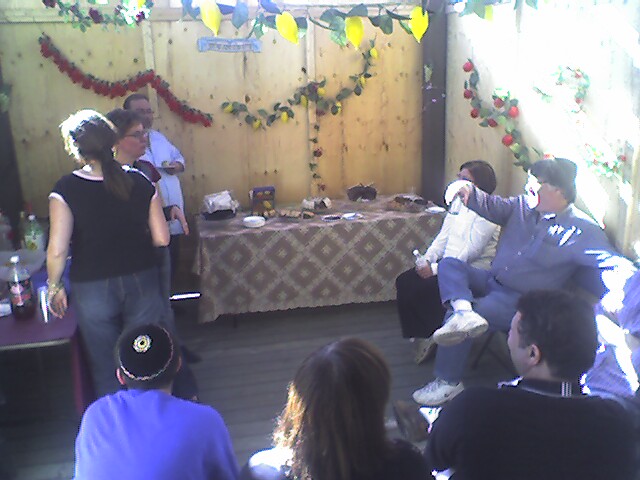
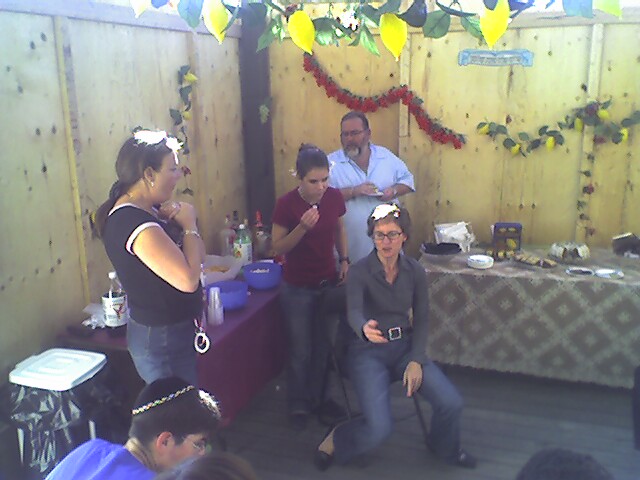
For those of us without Jewish roots we may be more familiar with the term Feast of Tabernacles (or Booths) than the term Succot. Being in a Jewish neighbourhood, we can see a few Succahs (booths) from our deck and today we were invited to share a meal and say a blessing in a neighbour's Succah. It was a great time of connecting with our neighbours (many of them were there) and to talk about the celebration from a Jewish and Christian perspective. Check out some of the pictures! It was a beautiful day. The Succah is required to be partially open to the elements and to be observant you should spend as much time in it as possible - even sleeping there if weather permits. If you want some more information on Succot and Jewish customs and holidays in general check out Judaism 101.