Showing posts with label Jewish. Show all posts

Tuesday, April 15, 2008

Intention and Kavanah

Our lives are so full. Our world is so busy. We move so fast and so hard and so long. We have become pulled in so many directions – I believe mostly because of the media – that is the prevalence of media messages bombarding us every day: commercialism (buy this, get those, go there, drive that); environmentalism (recycle, go green, reduce your carbon footprint, the polar ice caps are melting); health (cancer, cell phone towers, bottled water); and lions and tigers and bears, Oh my! We are so fragmented that our core suffers. Our core is that place of true identity inside that defines who we are and where we are going. It provides meaning and purpose. It is the place our life story resides – our metanarative – the story that makes sense of all the little parts of our lives and lines up all the diverse, going-every-which-way segments into a meaningful direction.

This core, facing the bombardment of dailyness, gets chipped away and shrivels smaller and smaller until we have to hide it away just to protect it from the demands of the world. The result is that we become not a person but a collection of scattered and fragmented pieces loosely held together by our physical life (our body – i.e. where we are and what we do) instead of held together by the core of who we are – held together by our story. So church (or more importantly our lives lived out of worship) becomes one more fragment to piece together with the rest of our lives.

That’s how I’ve been feeling – fragmented. What is my “core?” That space from which I live my life? It used to be clearer – it is always much clearer when I’m working on a new plan but it gets more and more fuzzy the longer I live in that space. It needs to be continually reinvented and renewed. This core to me is a combination of soul and spirit. The spirit is that which is in connection with God, that is reborn when we truly encounter and surrender to the risen Christ. It is eternal. But our soul is that which processes all that we live in and through here on earth. It is the soul (mind, emotions and will) that needs renewal and regeneration. It is the soul where we must renew the mind and submit our will to God and express our desires or reign in our emotions.

It is somewhere in there that we get fragmented. Our desires become thin and fleeting. Our thinking becomes shallow and overly affected by sound bytes and political correctness. Our will bends to the whims of the spirit of the age.

That’s where kavanah comes in. In the Jewish tradition, intention, kavanah, is an essential part of meaningful action. The term kavanah comes from the Hebrew root meaning to direct, intend, focus. The rabbis were very clear that living a meaningful life involves combining both the actions we do and the intention we bring to those actions. For example, the rabbis stressed that prayer was not just about the act of reading or saying the words of a prayer. If you did not pray with kavanah, actively thinking about the words you were saying, you have not fulfilled your obligation to pray. It describes the centering that happens when we are able to line up all the little pieces of our into that purpose of God. That is living in the moment, being single minded, identifying with Paul who said:

But one thing I do: Forgetting what is behind and straining toward what is ahead, I press on toward the goal to win the prize for which God has called me heavenward in Christ Jesus. Philippians 3:13b-14

A quote from Martin Buber comments sums it up, "He who does a good deed with complete kavanah, that is, completes an act in such a way that his whole existence is gathered in it and directed in it towards God, he works on the redemption of the world, on its conquest for God.
quoted from the Shaping of Things to Come.

I suppose this also applies to a community. It would also be more effective if an entire worshipping community can gather itself up to advance the Kingdom and do good deeds with Kavanah – that is completing an act in such a way that all of its identity is gathered together towards the same direction and towards God. It would be most effective if all of its life was concentrated in one direction and fundamentally in the direction of honouring God. Doing that with the diverse types of people you have in a congregation would be a significant challenge - and is the fodder for another post.

Tuesday, October 02, 2007

The Godhead in the Old Testament

Most of us recognize the Jewish roots of Christianity and most of us also acknowledge that Christianity wouldn't even make much sense without an understanding of the Jewish context. Unfortunately much of our Jewish understanding has come from the New Testament without really understanding how that was shaped by the Torah and the Prophets. I have long been fascinated with the precursor images of Jesus presented in the Old Testament and even how Jewish scholars also recognize that these passages speak of a less than rigidly monotheistic YHWH. (If you really don't find this type of stuff interesting you might want to skip this post. My daughter just came down and saw what I was working on and said "That looks really boring Dad." I said; "Actually, it is fascinating!" Her answer? "That's nice Dad.")

Some of this material is found in a number of excellent books that speak of the Jewish roots of Christianity (Our Father Abraham and In The Shadow of the Temple). One of the best Christian apologetic books in my mind is actually a series of books by Michael L. Brown called Answering Jewish Objections to Jesus particularly Volume 2: Theological Objections.

The other excellent online resource is a lecture given by Michael Heiser called The Concept of a Godhead in the Old Testament. It is available as a podcast or MP3 - but you can see the powerpoint presentation he used if you listen to it online. (You will need a high speed connection) If this is interesting to you or if you have frequent conversations with Jewish Rabbis, it is worth the hour it takes to listen to it.

In this lecture Heiser presents material that shows that there are:
1. a number of very significant Old Testament passages which show the presence of YHWH and of "another" God-like figure at the same time (Exodus 3:1ff with Moses at the burning bush, Exodus 34:5-7 where the Lord passes by while also covering Moses eyes; Judges 6:11-14 where the angel and YHWH are both called the Lord and Genesis 31 and 32 where Jacob wrestles with an angel and says he wrestled with God).
2. an even greater number that speak of YHWH appearing in physical form, speaking, touching and even eating (the angel wrestling with Jacob, 1 Sam 3:10 where the Lord comes and stands beside Samuel, Jeremiah 1:1-9 where the word of the Lord reaches out his hand and touches Jeremiah and Genesis 18 where the Lord appears to Abraham and actually sits down and eats).
3. a number of Jesus style "descriptors" that are used that are considered to be God or to be equal to God (the "name of the Lord, the angel of the Lord, the word of the Lord and even "wisdom").
4. And that there are even a few passages that suggest the Trinity (Isaiah 63:7-10 mentions YHWH, the angel of the Lord and his Holy Spirit especially when seen in parallel with Psalm 78:40-41).

Up until the second century Jewish scholars acknowledged these passages as evidence of two YHWHs - one seen and and the other unseen. Philo even calls the seen YHWH the Logos! But of course after the explosive growth of Christianity after the second century (and perhaps because of some anti-semitic behaviour and of course the destruction of the temple) Judaism distanced itself from the emerging Christian movement by reinterpreting some of these OT Christian precursors.

If you can, I would highly recommend listening to the lecture. I think you would enjoy it.

Thursday, September 06, 2007

High Holy Days

L'Shanah Tovah (Happy New Year) & Chag Sameach (Literally, joyous festival.)
Well technically the first phrase is L'shanah tovah tikatev v'taihatem (May you be inscribed and sealed for a good year). If you want to impress your Jewish neighbour say the whole phrase - and know what it means (some less observant Jews may not know).

As the Jewish High Holy Days approach (Rosh Hashanah begins on the evening of September 12th and Yom Kippur is sunset September 21, 2007 - nightfall September 22, 2007) my neighbourhood is abuzz with preparations. There is significance for us who profess that Moshiach has come in Jeshua as well because the Jewish feasts reflect Biblical events and concepts and point toward the coming of the Messiah.

Each one of God’s Feasts contains basic elementary truths, which are foundational in revealing His Holy character, man’s nature and our faith in Him. As we become aware of the fundamental essentials of each Feast, we gain a deeper understanding of God’s Person and His personal love for humanity. Each one of God’s Appointed Times (feasts) contain the following basic elements (there are more):

The Commemoration of a monumental event. Each Feast Day recounts something fantastic God has accomplished mainly for, but at times in conjunction with, His covenant people.

The Unveiling of Components of His redemptive plan for humanity. God discloses His plan to bring about redemption through the subject matter of the individual Feasts and as God’s Feasts are celebrated, an amazing redemptive portrait reveals itself through the unique practices of the Feast and through the types of sacrifices and the ceremonial protocol outlined for the Tribe of Levi.

The Revelation of His Character through types and shadows. The Person of Messiah is made known through a variety of spiritual and physical appearances, and through miraculous components imbedded within the original historic event.

The High Holy Days are no exception, as a matter of fact, it is in these last three Feasts on the Jewish calendar where the Personhood of Yeshua’s Messiahship and His Crowning as King over all becomes clearly evident. Through these monumental Festival events God’s redemptive plan for Israel is revealed through types and shadows. So, for believers the Feasts of Rosh Hashanah (Trumpets), Yom Kippur (Day of Atonement) and Sukkot (2nd Harvest & God Among us) reveal Messiah as Redeemer, Conqueror and King.

Rosh Hashanah in the Bible
“Again the LORD spoke to Moses, saying, ‘Speak to the sons of Israel, saying, “In the seventh month on the first of the month, you shall have a rest, a reminder by blowing of trumpets, a holy convocation. You shall not do any laborious work, but you shall present an offering by fire to the LORD.’” Leviticus 23:23-25 NASB

Rosh Hashanah Facts
• Rosh Hashanah literally means “Head of theYear” and this is why it is commonly referred to as the Jewish New Year.
• In the Bible, Rosh Hashanah is calledYom HaTeruah or “Day of the Shofar”.
• The command from God concerning the shofar blasts, or the “blast of horns” can be found in Leviticus 23:24 and Numbers 29:1.
• The Bible also calls this dayYom Ha-Zikkaron or “The Day of Remembrance”. Rabbinic Judaism interprets this to mean that the creation of the world by God’sWord was actually on the day of Rosh Hashanah. Therefore, it is “the commemoration of the creation of the world” and Jews are reminded of their responsibilities as God’s chosen people.
• Rosh Hashanah is the beginning of the “Days of Awe” or the 10 days between Rosh Hashanah and Yom Kippur.
• Rosh Hashanah is known by the rabbis as the “Day of Judgment” and it is believed that God judges all of His people on this day and decides on their fate for the next year.
• Maimonides regarded the shofar blasts on Rosh Hashanah as an allusion to Isaiah’s proclamation, “Awake, O you sleepers, awake from your sleep! O you slumberous, awake from your slumber! Search your deeds and turn in repentance!”
• Another long-standing rabbinic tradition is called Tashlikh, or the “Casting off of Sin”. On Rosh Hashanah, many Jews walk to a creek or a river and cast bread crumbs into it, symbolizing the casting off of their sins of the previous year. This is done on the afternoon of the first day of Rosh Hashanah.

Yom Kippur in the Bible
“And He,YHVH spoke to Moses, saying: ‘On the tenth day of this seventh month is the Day of Atonement; there shall be a holy convocation unto you, and ye shall afflict your souls; and ye shall bring an offering made by fire unto YHVH. And ye shall do no manner of work in that same day; for it is a day of atonement, to make atonement for you before YHVH your God.’” Leviticus 23:26-32

Yom Kippur In The Synagogue
• The 10 days between Rosh Hashanah and Yom Kippur are known as the “Days of Awe.” During this period,
“mitzvotim”, or good deeds, are done to make up for bad behaviour during the past year.
• Yom Kippur, celebrated on the 10th day of Tishri, is the most important and solemn of Jewish holidays, next to
the Shabbat due to its frequency.
• Yom Kippur is the occasion on which otherwise non-observant Jews are most likely to attend synagogue, refrain
from work, or fast.
• Throughout the Day of Atonement, Jewish people seek God’s forgiveness through fasting and prayer.
• No leather is worn on this day in remembrance of the sacrifices once offered by the priests in the temple.
• The Day of Atonement is believed by the rabbis to be the people’s last chance to change God’s mind concerning
the judgment of one’s deeds in the previous year, and their humility will effect His decision over one’s fate in
the coming year.
• It is traditional to break the fast of the day with an evening congregational meal.
• In the Bible,Yom Kippur is called, “Shabbat Shabbaton” (Sabbath of Sabbaths); because it is on Yom Kippur that all the people of Israel are to abstain from work and focus inwardly and solemnly, therefore, characterizing a Shabbat of the most complete rest.

Thanks to Light of Messiah Ministries newsletter for much of this information. For a website from a Jewish perspective with lots of helpful information about Jewish culture and holy days check out Judaism 101.

Sunday, September 02, 2007

Interesting

In honour of the upcoming Jewish High Holidays I thought I'd share this little tidbit. All 24 letters of the Hebrew alphabet (the alephbeht) can be found in the Magen David (the Star of David).

Saturday, March 17, 2007

Evangelicals and Israel

Just connected with a site reporting on the most recent AIPAC confereence (American Israel Public Affairs Committee) where Rev. John Hagee was speaking on why Christians support Israel. He didn't really say a lot of new things but the reaction of the mostly secular Jewish crowd is quite amazing.

The video is youtube and not great quality but the sound is good. It's in three parts.

Read some of the comments below the video link. They are also quite interesting.

Check it out here.

Tuesday, November 28, 2006

Life Passages

I guess when you hit 50 you start having less to say. I posted a week and a half ago and then had a busy weekend. We attended a friend's son's Bar Mitzvah - both the synagogue portion and the party the next evening. Everything was top notch. Adam, the Bar Mitzvah boy did great in his reading, the food was fabulous, the party was great and our hosts are such great people.

I actually think that the rite of passage concept (like a bar Mitzvah) is actually a great concept for youth and helpful for their transition into adulthood. However in our culture ... it may be more helpful to be doing it a few years later than the entrance into teenager-hood. Those early adolescent years are tough. They still seem like children in so many ways. In some places they do a sweet 16 party for girls. That seems to me to be a better age to do a coming of age event.

I think we should do a big party for every significant transition. We already do birthdays. Weddings, graduations and retirement is all celebrated in some way. How about a moving away from home party when your adult children finally move out on their own? Well maybe it becomes one long party for the empty nesters. Or how about a "turning middle aged" party? Or maybe a mid-life crisis party? When exactly does that happen? How about a "halfway through raising your kids" party? This way you know how long you still have to go.

All in all I think life should have more parties. Jesus believed in parties. I think being with Jesus would actually have been lots of fun - challenging to the core, but fun. Raising dead people, calming storms, healing lepers, confronting the religious establishment, feeding 5000 people, lots of road trips. There was always a crowd and lots of opportunity to celebrate life and life passages.

Sunday, October 08, 2006

Succot


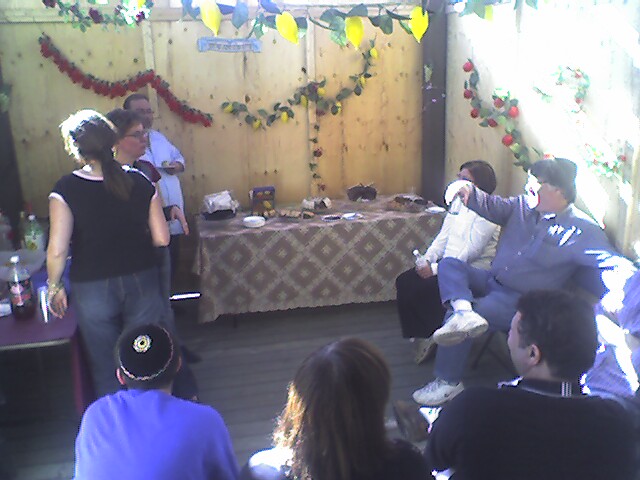
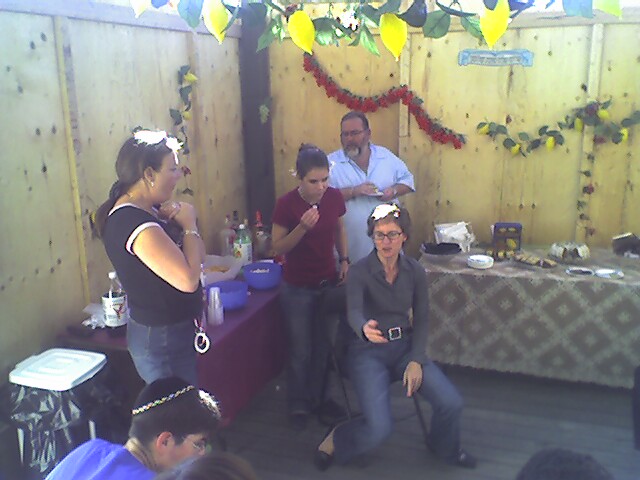
For those of us without Jewish roots we may be more familiar with the term Feast of Tabernacles (or Booths) than the term Succot. Being in a Jewish neighbourhood, we can see a few Succahs (booths) from our deck and today we were invited to share a meal and say a blessing in a neighbour's Succah. It was a great time of connecting with our neighbours (many of them were there) and to talk about the celebration from a Jewish and Christian perspective. Check out some of the pictures! It was a beautiful day. The Succah is required to be partially open to the elements and to be observant you should spend as much time in it as possible - even sleeping there if weather permits. If you want some more information on Succot and Jewish customs and holidays in general check out Judaism 101.

Sunday, October 01, 2006

Sunday's Word

It's Yom Kippur tonight - Kol Nidre. The most holy night in the Jewish calendar. I was out for a walk tonight and saw many of my Jewish neighbours walking back from synagogue and had a few conversations. Appropriate that we had communion this morning at church. Most Jews - event the most secular - will fast from a half hour before sundown tonight until a half hour after sunset tomorrow. This day is, essentially, your last appeal, your last chance to change the judgment of G-d against you, to demonstrate your repentance and make amends.

Yom Kippur atones only for sins between man and G-d, not for sins against another person. To atone for sins against another person, you must first seek reconciliation with that person, righting the wrongs you committed against them if possible. That must all be done before Yom Kippur.

In light of Yom Kippur, I spoke today at church that I have a sense that God is doing some transitioning - some shifting. I am led to feel that for a number of reasons: the significant number of deaths happening around me, the many transitions happening in the lives of the people of Hills (a marriage, kids going to university, workplace issues, a wedding cancellation). There are some significant transitions happening in other churches in Thornhill - pastoral changes, internal difficulties. And yet there are some good things too: lives being changed, people discovering God, spiritual maturity, even some church growth.

However, every time there is positive movement there is resistance - human and spiritual resistance. I listed five ways to respond to this resistance.
1. Hear from God - we need to make a concerted effort to spend time reading Scripture and listening to God
2. We need personal holiness - a commitment to live right all the time - not just live in with what we can get away with. That means quickly dealing with the things in our lives that we have done wrong by confessing them as sin (agreeing with God that it's wrong and not trying to justify it), repenting (turning away from it), and making restitution if we have to. This needs to be done daily - not just once a year (no offense to my Jewish friends).
3. Unity - unity of prayer, lack of strife and unforgiveness among us. Jeshua said that where two or three are gather together He is there in the midst of them.
4. We need to pray - with all kinds of prayer, on all occasions, with all fervency.
5. Action. We need to act out what we believe. We need to live holy, love our neighbours, share our lives and our faith, do good deeds, bless the people around us, and take advantage of the opportunities that God gives us in the divine appointments He creates.

That was my challenge. We are gathered as this little group in this specific place for such a time as this - and we need to be making a difference.